Shopping With Crypto: What to Know Before You Pay
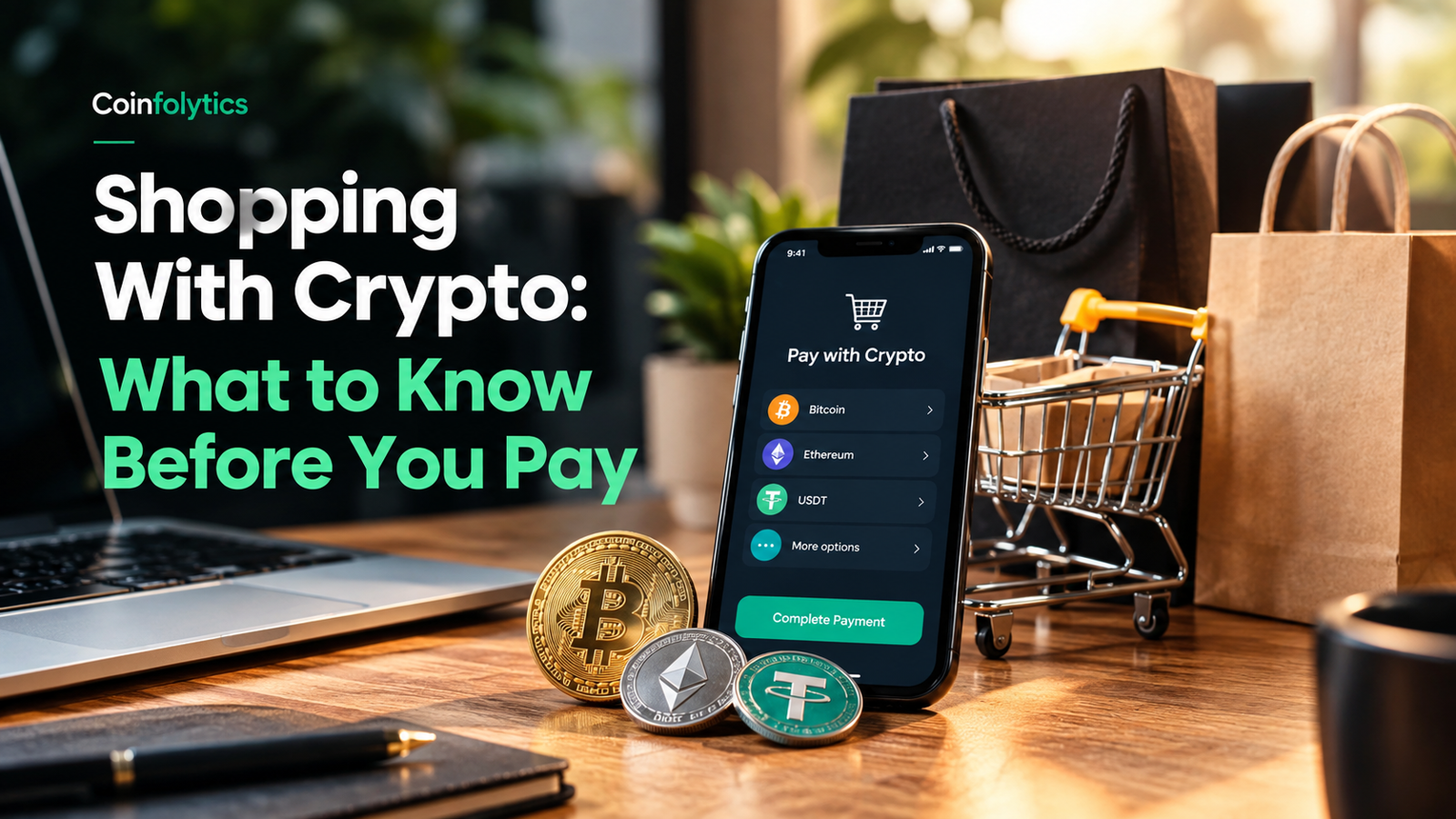
Paying for something real with crypto is no longer a novelty. It is also not quite the same as tapping a card, and the differences are concentrated in about five places. Every one of them is easy to get right once you know it exists, and expensive to get wrong the first time.
This is what to know before you pay — written for someone who holds crypto and is thinking about spending it, rather than someone who needs convincing that it works.
It is more common than it looks
The perception is that crypto is for trading and holding, and that almost nobody buys anything with it. The first half is true; the second half stopped being true recently.
In the National Cryptocurrency Association's 2026 State of Crypto Holders report, 40% of crypto holders said they had used crypto to buy goods or services, and the share of holders doing nothing at all with their coins fell from 20% to 13%. Retail-sized stablecoin payments reached roughly $70 billion globally in 2025, up about 83% year on year, according to Flagship Advisory Partners.
That is still tiny beside the card networks. But it means that if you are considering spending stablecoins on physical goods, you are not an early adopter doing something strange. You are part of a group measured in millions.
Mistake one: sending on the wrong network
This is the only mistake on the list that can cost you the entire payment, so it goes first.
USDT is not one thing. It exists on Tron, on Ethereum, on Solana and on several other networks, and the versions are not interchangeable. The deposit address you are given belongs to one of them. Send Tron USDT to an Ethereum address and the funds do not bounce back — they land somewhere nobody can reach.
The fix takes five seconds: read the network on the payment page, then check the network on your wallet's withdrawal screen, and make them match. Not the coin — the network. Exchanges label this differently (TRC-20, ERC-20, BEP-20, Base, SOL), which is exactly why people get it wrong.
If you are ever unsure, send a small test amount first. On Tron or Base that costs cents.
Mistake two: treating the quoted amount as permanent
A card authorisation happens in about a second. A crypto payment is quoted, then sent, then confirmed, and those three things happen minutes apart.
Because of that gap, the crypto amount you are shown is fixed only for a window — there is a countdown on the payment page. Send inside the window and the amount is right. Send after it and you have underpaid against a stale quote, because the rate moved while the tab sat open.
If the countdown runs out, do not send. Start the checkout again and take the fresh amount. If you have already sent late, the funds are not gone; contact support with the transaction hash and it can be reconciled manually. It is just slower than doing it in the window.
Mistake three: sending roughly the right amount
Card payments take the exact figure. Crypto payments take whatever you send, which means a typo or a rounding-down becomes a real state called partial payment.
Underpay and the order will not complete until the balance arrives — you will be prompted to top up the difference. Overpay and the excess has to be returned to you manually. Neither is a disaster, but both turn a two-minute purchase into an email thread.
Two practical points. Copy the amount rather than typing it. And remember that your wallet's network fee is charged on top, not deducted from what you send — so make sure your balance covers the amount plus the fee, or the send will fail or arrive short.
Mistake four: spending the asset you would rather have kept
This one costs nothing on the day and can cost a lot at tax time.
In most countries, using crypto to buy something is treated as disposing of it. If the coin is worth more when you spend it than when you acquired it, the difference is a taxable gain — the purchase is ordinary, but the disposal is what the tax authority looks at. That is the position in the United States, the United Kingdom, Canada, Australia, France and Italy. Germany exempts gains on crypto held over a year. Singapore has no capital gains tax for individuals, and the Netherlands taxes holdings rather than the moment you spend.
The practical consequence is simple. Spending $200 of stablecoin creates a gain of essentially nothing, because stablecoins barely move. Spending $200 of Bitcoin you bought years ago creates a gain on the whole appreciation, and you have to account for it.
So if you hold both, spend the stablecoin and keep the Bitcoin. It is faster, cheaper and cleaner in every direction. (This is general information, not tax advice — the rules change and your situation is your own.)
Mistake five: assuming a chargeback exists
It does not. A crypto payment cannot be reversed by a bank, because no bank is involved. Nobody can claw the money back on your behalf — which is exactly why merchants like it, and exactly what you are giving up.
What replaces it is the seller's own refund policy, so read it before you pay rather than after. The things worth establishing: who pays return shipping, how long you have, and in what form the refund arrives.
On that last point, ours is worth stating plainly because it is not obvious: refunds are paid in USDT regardless of what you paid with, based on the value of your order at the time of payment, and our payment processor's fee is deducted. The exception is the statutory 14-day cooling-off period in the EU and the UK, where the refund is the full amount with nothing deducted. If you pay in Bitcoin and its price rises before you return something, you get the order value back in USDT rather than the same number of coins — which is one more reason to pay with a stablecoin.
Stablecoin or Bitcoin?
For shopping specifically, the answer is nearly always a stablecoin. Here is why, side by side:
- Price certainty — USDT and USDC are pegged to the dollar, so the amount quoted is the amount you expect. Bitcoin's amount is fixed only for the quote window.
- Speed — roughly a minute on Tron or Base. Bitcoin can take ten minutes to an hour when the network is busy.
- Fee — around a dollar on Tron, cents on Base. Bitcoin is usually several dollars.
- Tax — a stablecoin disposal produces a negligible gain. A Bitcoin disposal may not.
- Refunds — paid in USDT, so paying in USDT means no conversion surprise in either direction.
Bitcoin is a fine thing to hold. It is a slightly awkward thing to shop with.
A two-minute checklist
Everything above, compressed:
- Pay with a stablecoin if you hold one.
- Match the network shown on the payment page to the one your wallet is sending on.
- Check your balance covers the amount plus the network fee.
- Copy the exact amount, and send inside the countdown.
- Read the refund policy before paying, not after.
- Do not close your wallet app mid-send — but you can close the shop's page once the transfer is broadcast. Confirmation is handled on the server, so the order completes whether or not you come back.
Where to go next
If you want the full detail — every coin and network accepted, the checkout steps with screenshots, delivery by country, the tax position in each market and the complete refund terms — that lives on our buy with crypto page, which is the reference version of all of this.
If you would rather just look at things to buy, the categories crypto shoppers reach for most are console and gaming accessories, keyboards and mice, chargers and power banks, everyday carry and smart home.
Whichever you pick, the rules are the same five. Match the network, mind the countdown, send the exact amount, spend the stablecoin, and know the refund terms before you pay.
Related Posts
Latest Posts


Explore the Shop